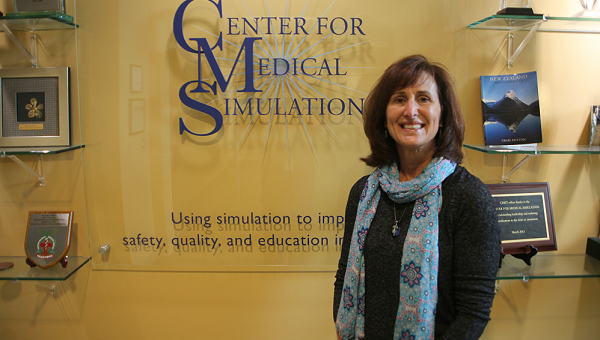
The Center for Medical Simulation Home Page
Left of NavigationThe Center for Medical Simulation Homepage linkThe Center for Medical Simulation About Page LinkThe Center for Medical Simulation Clinical Training Page LinkThe Center for Medical Simulation IMS Page LinkThe Center for Medical Simulation Healthcare Adventures PageThe Center for Medical Simulation Customized Services Page LinkHarvard Med Sim BlogThe Center for Medical Simulation Course Calendar Page Link
Contact Us
Directions
FAQ
Resources
Research
Graduates
Stay Informed Join Our Mailing List

CMS FacebookCMS TwitterCMS You TubeCMS Linked In

Accredited by the American College of Surgeons and endorsed by the American Society of Anesthesiologists.

The American College of Surgeons and The American Society of Anesthesiologists Logos

CMS Update

Jeff Cooper has written an editorial entitled, “Using Simulation To Teach and Study Healthcare Handoffs” for the August 2010 edition of Simulation in Healthcare. As Jeff notes in his editorial, Patient Handoffs, also called handovers or shiftchanges, are considered one of the most critical issues in patient safety. Read about Jeff’s thoughts on using simulation to raise awareness and hopefully help reduce the risk of handoffs.

Both Jeff and Dan Raemer are in Australia this week at the SimTecT Health 2010 conference. SimTect Health is the annual conference for the Australian Society for Simulation in Healthcare. Monday evening Jeff and Dan hosted a reception for Institute for Medical Simulation graduates. And, both are speakers at plenary sessions, round tables and workshops.

(more…)

Dan Raemer to be Visiting Professor in Australia

In early September, Dan Raemer PhD, CMS’ Director of Research and Development and Associate Professor at Harvard Medical School, will spend a week as a visiting professor at the Hunter New England Skills and Simulation Centre in New Lambton, New South Wales Australia. On September 8th, Dan will be lecturing on the challenge of challenging others at ICU Grand Rounds at the  at the RNC Lecture Hall.

Jenny Rudolph attends The Academy of Management Annual Meeting in Montreal

Jenny Rudolph PhD, a principal faculty member at the Center for Medical Simulation, is spending the week presenting and learning from colleagues on issues related to debriefing and teamwork at the Academy of Management Annual Meeting in Montreal.

Jenny writes, “The conference has been incredibly refreshing and I’ve been on a steep learning curve in ways to improve debriefing and on-line learning. I’ve attended sessions that help me rethink the role of listening in the debriefing process and I’m rethinking about how to learn and teach listening skills as vital part of debriefing. I’ve also been learning about Second Life as an on-line teaching tool as well as ways to evaluate and design on-line learning.” (more…)

SimTecT Health 2010: Education and Innovation in Healthcare

SimTecT Health 2010, the premier healthcare simulation conference in the Asia Pacific region will be held from August 30 through September 2, 2010 at the Hilton on the Park in Melbourne, Australia. The conference is sponsored by the Australian Society for Simulation in Healthcare – ASSH http://www.sdc.qld.edu.au/assh.htm

This year’s conference will explore the theme “Investing in the Future” and will bring together national and international experts from a range of clinical, educational and research disciplines together with policy makers and health services.

CMS’ own Jeff Copper and Dan Raemer will be among the Keynote Speakers and will also be conducting several workshops at the conference.

Jeff Cooper:

Thursday 8:30-10:30 Plenary: Teamwork in healthcare and among simulation professionals: Who needs the training first?

Monday 13:30-17:00 Workshop: Using Safety to Advance Simulation and Visa-Versa

Wednesday 11:00-12:30 Workshop: Reviewer and author training

Tuesday 13:00-15:00 Workshop (with Jenny Weller): Things that Changed my Practice

Thursday 11:00 Talk: Healthcare Adventures (simulation for teamwork training for non-clinical managers and leaders)

Dan Raemer:

Thursday 1100-1230 Workshop (with Richard Morris): Speaking up

A Life in Patient Safety: A Conversation with Professor Jeff Cooper

 Jeff Cooper, Executive Director of CMS. was recently interviewed  for the  ANZCA Bulletin (Austalian and New Zealand College of Anaesthetists). The first installment of  the interview entitled, ”A Life in Patient Safety: A conversation with Professor Jeff Cooper”, appeared in the June 2010 edition of the Bulletin. In this part, Dr. Cooper discusses his background and how he became involved in patient safety.  In the second part, which will appear in the September edition,  Dr. Cooper talks about the achievements in patient safety made so far, and outlines his thoughts on the work that still needs to be done. The interview was conducted by Dr Cate McIntosh, Director of Simulation at the Hunter New England Skills and Simulation Centre, and Consultant Anaesthetist in the Department of Anaesthesia, Intensive Care and Pain Medicine at John Hunter Hospital in Newcastle Australia.

The first installment of the interview appears below:

Summer Volunteer – Medical Simulation Experience

Earlier this summer we had the good fortune to have Phillip Telenfus, a first year Medical Student, spend a month as a volunteer here at the Center for Medical Simulation. Phillip finished up a few weeks ago and was kind enough to write about his experience as a volunteer at CMS.  I hope you enjoy reading about it as much as I did.

SUMMER VOLUNTEER – MEDICAL SIMULATION EXPERIENCE

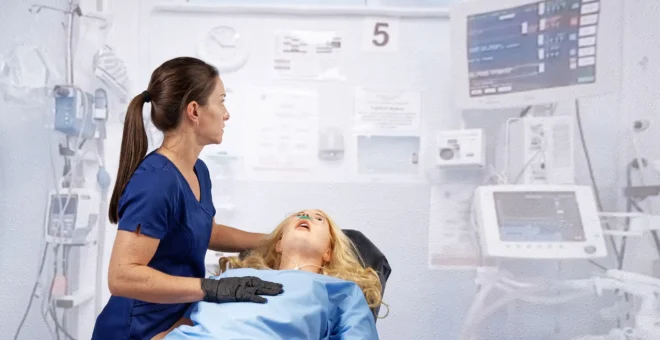
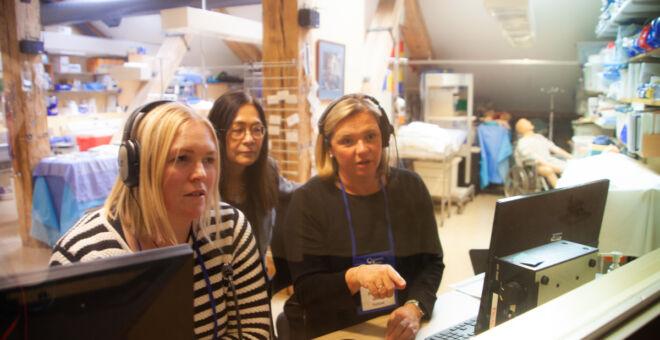
Entering an operating room for the first time is an exhilarating experience for a first year medical student. The patient covered in blue drapes, the lights, the monitors and the trays of silver instruments create an intense environment. As I stand next to the operating table, I observe the scene. The mood is busy but peaceful. People whisper. Everyone has their own job to do.  I pay attention to the words and learn like a sponge: crichoid pressure, ET tube, Art-line, scalpel, bovie, suction. As a 1st year medical student who is accustomed to the classroom  setting , I find  myself in foreign territory assisting  a team of anesthesiology residents  and staff in the management of  a  critical  patient with  malignant hyperthermia.  In this scenario however I am not a medical student. I am a scrub tech. I am listening to the control room through a speaker in my ear. My fellow confederates in the operating room are giving the team clues and guide them as they work through the differential diagnosis and treatment options. I am not a real scrub tech. The woman in front of us covered in sterile drapes is not a real patient but a robotic mannequin. Welcome to the world of medical simulation! A cutting-edge model for critical events training for residents and attending physicians at the Center for Medical Simulation in Cambridge, MA where I was able to volunteer for the past month.

During my month at the simulator center I observed and participated in many simulated medical scenarios from anesthesia crisis management to labor and delivery emergencies. The participant physicians came from all over the country and the world to become simulator trainers as well as engage in the program. My role at the center involved setting up the simulation rooms as well as acting as a variety of characters (nurse, scrub tech and even a family member) in the scenarios. While I observed the participants practicing technical skills, such as how to intubate a patient, start an intravenous line and deliver a breech baby in the simulator center, I learned that simulation is even more about learning the art of medicine. The practice of medicine, especially in critical cases, is a collaborative, group-oriented effort. I was impressed to see how some teams were able to come together, break down hierarchy and engage in effective communication and collaboration to maximize the patient’s outcome while other teams would miss the mark. I learned valuable concepts such as closed loop communication and advocacy inquiry. I learned that the most effective team leaders listened more than they talked as they summarized the situation, they asked for help and verified that help was on the way. The medical simulation environment is an amazing opportunity for any medical student and I feel fortunate to have had this wonderful opportunity to be exposed to the science and art of medicine. In conclusion, my search for an active, clinical experience this summer was a success at the Center for Medical Simulation and I hope to return and continue my learning there as I progress through my medical education.

 Phillip Telefus, Medical Student – CMS Volunteer

Highlights from the American College of Surgeons Meeting

I recently attended the annual meeting of the Accredited Educational Institutes of the American College of Surgeons (March 12 & 13). A few highlights:

Watch for a publication that should appear soon in Pediatric and Critical Care Medicine describing a study that demonstrates the effectiveness of simulation in improving the outcome of pediatric codes. Well-designed and real outcomes.

The keynote was by the CEO of a company that does the animation for Hollywood movies. He showed how “Benjamin Button” was made. The Brad Pitt character was said to be 90% digital. It’s not a big leap to imagine how we aren’t far from having the tools (more…)

The Center for Medical Simulation Home Page Link The American Society of Anesthesiologists Logo American College of Surgeons Logo